
There are so many ways to fill a home. Yet once the essentials—or the ones that some might deem necessary—have been assigned their spots in your abodes, then what comes next? For some, the design approach is already a marker of your preferences: some attempt to be as creative with their homes as possible, others are inspired by the lands they’ve travelled to. Creams, rustic woods and coastal vibes, for those who dream of summer waters and the Mediterranean; clean lines, natural woods and a touch of botanics for those who adore Japan’s minimalist aesthetic. But it doesn’t have to end there—especially if you’ve always imagined your living space to grow and evolve with you. Your own little corner of the world should be an extension of yourself, and what better way to do it than to fill it with the art you love?
However, the task can feel daunting. With the art world one commonly associated with long term investment pieces and high brow taste, where does one even begin? Perhaps, it doesn’t hurt to look to the experts for assistance. After all, all art collectors begin somewhere. In the instance of Krystina Lyon and Mark Budden—both retired from careers in the design and brand development industry in the UK and Singapore—the art of collecting has been a part of their way of life since they first got married. Today, their shared home is a quiet yet bold reflection of the art that have enriched their travels and what they’re both drawn to; his, inflected by modernism with a preference for minimalism, hers, maximalist, with a focus on the practices of female artists in Southeast Asia.
Then there are also those who curate for a living. Deborah Lim, an independent curator who previously worked on exhibitions like Iris van Herpen: Sculpting the Senses as the former Curator of Exhibitions at ArtScience Museum, fills her home with the works of friends or artists whom she and her partner admire across Singapore and Southeast Asia. The result is one that feels personal and intuitive, like a gallery that serves a more intimate purpose compared to the ones she curates in her professional life.
Here, we speak to a couple of industry folk—from Lim, to art collectors Lyon and Budden, as well as art historian and Plural Art Mag founder Usha Chandradas, and local illustrator Lauren, better known by her online moniker, @dirtydoodies—about the art they fill their abodes with, and their practical advice for curating for one’s home.
 ourtesy of Studio Vanssay
1 / 14
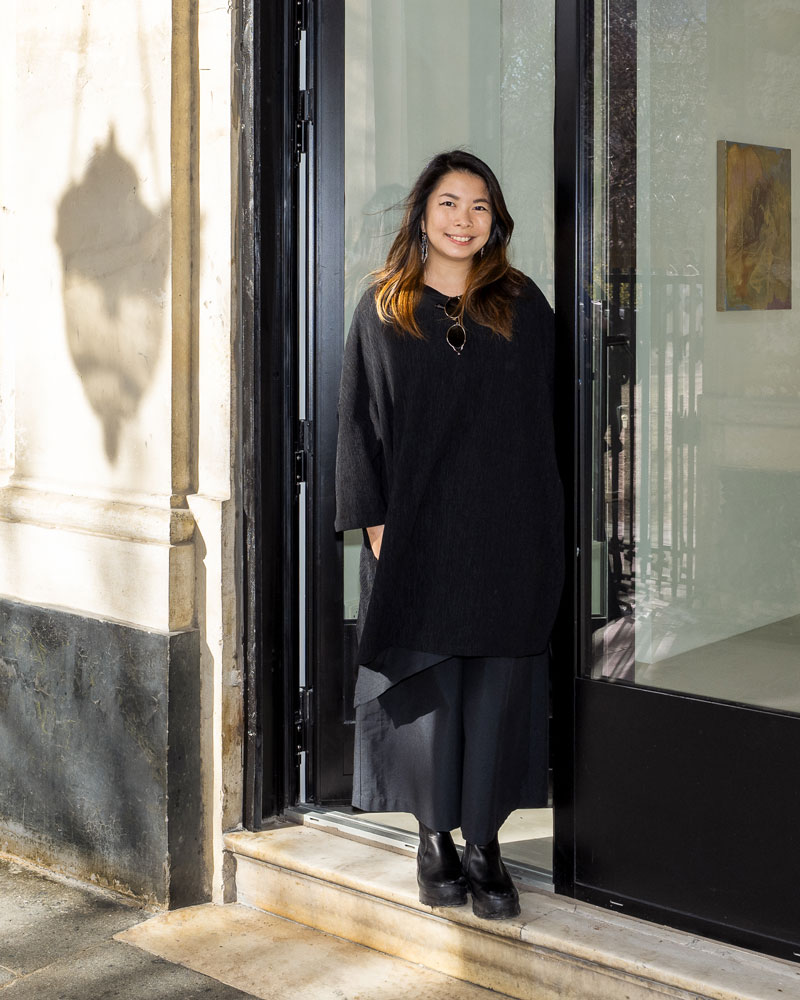
Deborah Lim, independent curator
How would you describe the art in your home—how did you decide on them?
The art in my home is a mixture of works I acquired myself and works that my partner and I collected together, it’s a shared space after all! It is a largely Singaporean and Southeast Asian selection of artists, most of whom are friends as well as people I admire and respect such as Speak Cryptic, Jay Ho and Ivan David Ng from Singapore and Iabadiou Piko from Indonesia. They are individuals I met along my journey in the art world, such as when I was previously Curator and Junior Partner at Chan + Hori Contemporary, a curatorial and artist management outfit in Singapore.
What sort of art are you personally drawn to? Do you tend to have a spot in your home in mind when you purchase an art piece?
I’m drawn to either abstract art or works that are quirky and tongue-in-cheek. I usually purchase the art first and then figure out a space that works for it at home. Once the works are delivered, they find themselves inhabiting a space in the home quite naturally and I tend to locate them where I am instinctively drawn to in the first instance.
2 / 14
Deborah Lim, independent curator
If someone were attempting to refurbish their living space, would you recommend they start small with the art they purchase?
I don’t think one necessarily needs to start small, but sometimes people feel more comfortable with a smaller purchase after which the collecting bug kicks in and it turns into a slippery slope of wanting more. I used to be of this mindset too and would only purchase small works, being afraid I’d run out of space, while my partner was the opposite. Some people are limited by the number of walls they have, or are simply looking for a single feature work for a living room area, it really depends on what suits the design of your home.
Should one be buying art that complements specific areas in a home?
One could do this if they were good at visualising what their homes needed in order to enhance each area. The easiest way would be to identify a rough size of the artwork one wants to purchase and keep an eye out for those dimensions when visiting galleries. However, I wouldn’t limit collecting art to this method—sometimes one walks into an exhibition and just falls in love with a work with no specific location in mind to place it. Always follow your instincts, purchasing art for the home is meant to be a fun and enjoyable process and it’s perfectly fine to build a collection slowly and thoughtfully.
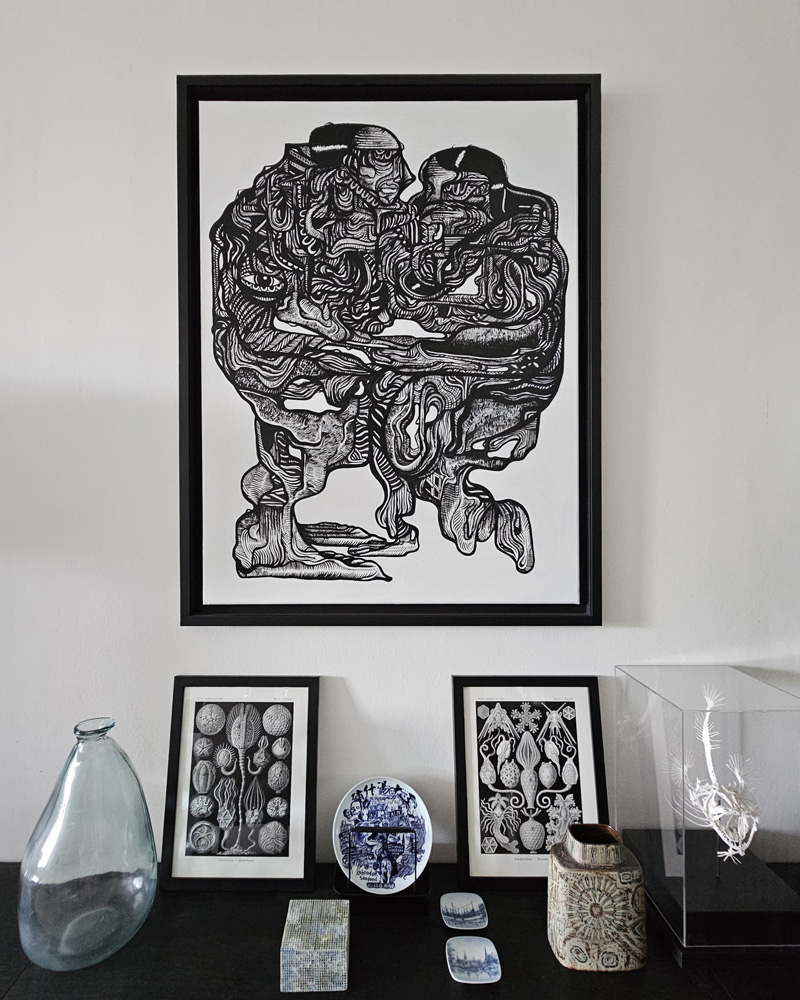
(top to bottom, left to right) ‘Painting by Speak Cryptic’, first edition prints by Ernst Haeckel; plate by Mojoko; anglerfish skeleton; Fajance ceramic; work by Ammar Idris; vintage plates from Copenhagen.
3 / 14
Deborah Lim, independent curator
How does one go about choosing a spot for an art piece—especially if they’re big statement artworks?
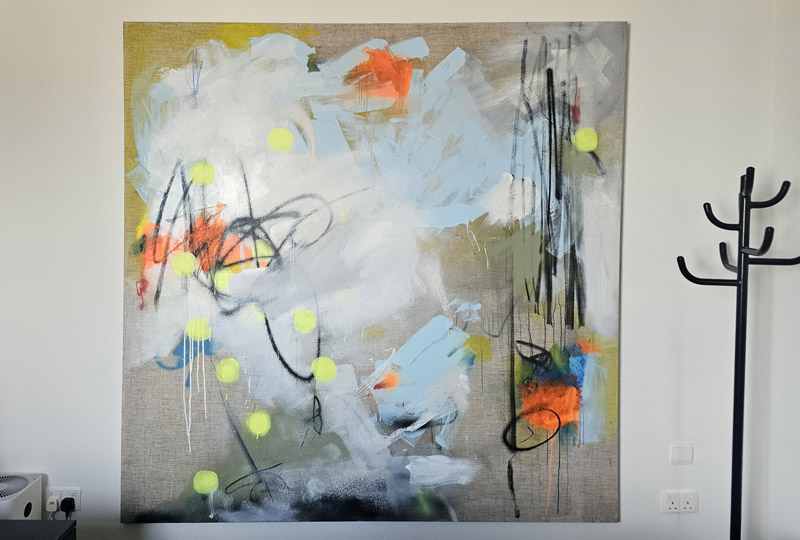
It depends on the effect one wants to achieve—I have an area in my home reserved mainly for monochrome works as the fittings and fixtures are black in colour. One could also paint the walls of a room a certain colour to complement artworks, my study is a forest green colour and my partner’s study is dark grey. Both these base colours work well as a foundation for an eclectic mix of artworks. Sometimes the art finds you rather than the other way around, my partner and I were at the first solo exhibition of Kiat (DJ and abstract painter) and we encountered the largest work of two by two meters titled ‘Ritalin’ that we could not resist. This was the largest work either of us had ever bought!
Up to that point, we had resolved most of the design of our apartment except the bedroom which felt like it was lacking something. We made the painting the statement piece of the room and rearranged the furniture around the artwork (which almost took up the entire available wall). The effect was pretty amazing, completed the room, and we are immensely lucky to be able to wake up to a stunning painting every day.
(wall) Kiat, ‘Ritalin‘ (2022), mixed media on linen, 200 x 200 cm
4 / 14
Deborah Lim, independent curator
With framing or maintaining artworks, what is your personal approach to displaying certain art pieces?
I tend to prefer framing paintings as it feels more complete, Ace Framehub has been my go-to framer for years. While black, stained wood (eg. walnut) or white frames are more common, I occasionally go for a statement frame such as a bright blue colour which dialogues with the artwork in a whole new light. Always speak with the gallery or artist when purchasing art to seek the best advice for maintenance and care of works. If dust accumulates on eg. sculptures or textured paintings, a fine powder brush can sometimes be used for light cleaning. I also like displaying artworks with other objects such as vintage trinkets and more unique items (including an anglerfish skeleton and taxidermied pufferfish)—every corner of my home unfolds many stories, some crazier than others.
What are some additional considerations for buying art for one’s own living space?
Think about how to get the art through your doors! There are sometimes limitations for lift dimensions of an apartment and it is not always easy to manoeuvre around corners. Beyond prints and paintings, artworks in other mediums add textures and layers to your home such as tapestries and ceramics. It’s all about building a universe that is distinctively yours.
(top to bottom, left to right) Artworks by Chong Yan Chuah, Renee Hauff, Mary Bernadette Lee, and vintage painting from Rio de Janeiro.

5 / 14
Krystina Lyon and Mark Budden, longtime art collectors
How would you describe the art in your home—how did you decide on them?
Our home style is warm and quite layered and the art we are attracted to tends to be pieces that hold memory, tension, resilience and beauty. Most of the artwork in our home is predominantly by Southeast Asian women artists whose practices explore identity, labour, migration and resistance. It is fair to say that the art we have collected does shape the overall feel of our home. Guests often remark on the art from the moment we welcome them in—there is scarcely a free wall in sight.
The artists we collect work across a wide range of materials—acrylic on canvas, ceramic, wood on metal, mixed media, bronze, hand-cut silk fabric, wool, painted wood-carving, lacquer, digital prints on archival paper, mosquito netting and local cut-out woven fabric. Many of the materials are organic which contributes to the home’s warm and tactile atmosphere.
We respond instinctively to the intent and conviction of a work, and we rarely hesitate when something resonates. We enjoy learning about each artist and their practice initially from the gallerist that represents them. That is an important relationship for us, and we are friendly with about half a dozen galleries who show artists we have come to know well. We rarely enter a gallery intending to acquire anything yet often leave having committed to a work and only later deciding where it will live. This is becoming harder as the space fills up but somehow there is always enough room for that special artwork.
Our ties to the art world extend not just to the commercial galleries but also direct to the artists and artist-led organisations themselves. Mark and I treasure the relationships we have made with the artists we have bought artworks from, and in almost every case, we have spent time talking to the artist about their practice. We also participate in studio and walking tours during Art SG and the annual exploration of private and public art spaces by OH! Open House.
6 / 14
Krystina Lyon and Mark Budden, longtime art collectors
With framing or maintaining artworks, what is your personal approach to displaying certain art pieces?
Mark’s skills as a designer are put to good use when it comes to displaying and framing the artworks. We will agree on a placement where the artwork feels most resolved (what artwork it is next to, the amount of white space that is comfortable between them, the distance from which to view comfortably) and he will often design an acrylic display cover or a plinth on which to display a sculpture or incorporate discreet lighting that enhances the work without overpowering it. He works closely with the framer to ensure the frames complement the artwork in terms of colour, material and where it is hung in a room. Developing a relationship with a skilled framer who understands your aesthetic is invaluable.
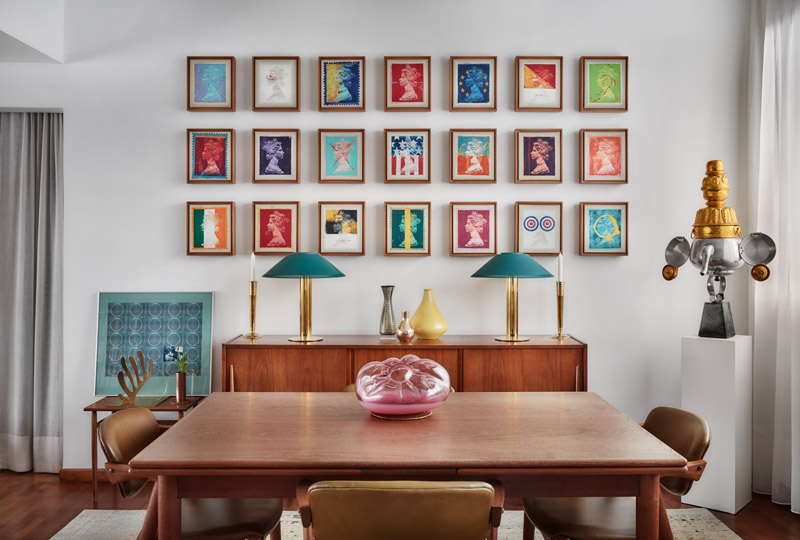
(clockwise from top centre) Kee Levi, ‘Stamps’, (series of 21), 1995, screenprint on canvas; Komkrit Tepthian, ‘God of Luck’, 2018, aluminium and marble base; Patricia Piccinini, ‘Ruby Examination’, 2022, hand-blown glass; Sinta Tantra, ‘Constellations of Being (Coral)’, 2022, brass and glass; Kee Levi, ‘K & M Kissing’, 1997, mixed media, colour photo, video still.
 Wong Weiliang
7 / 14
Krystina Lyon and Mark Budden, longtime art collectors
Should one be buying art that complements specific areas in a home?
We never buy art to match our interiors. Having honed our taste over the years, we instinctively know when a work will integrate harmoniously into our space. We have artwork in all areas of our home including the kitchen but we make sure that it is sturdy enough to withstand changes in temperature.
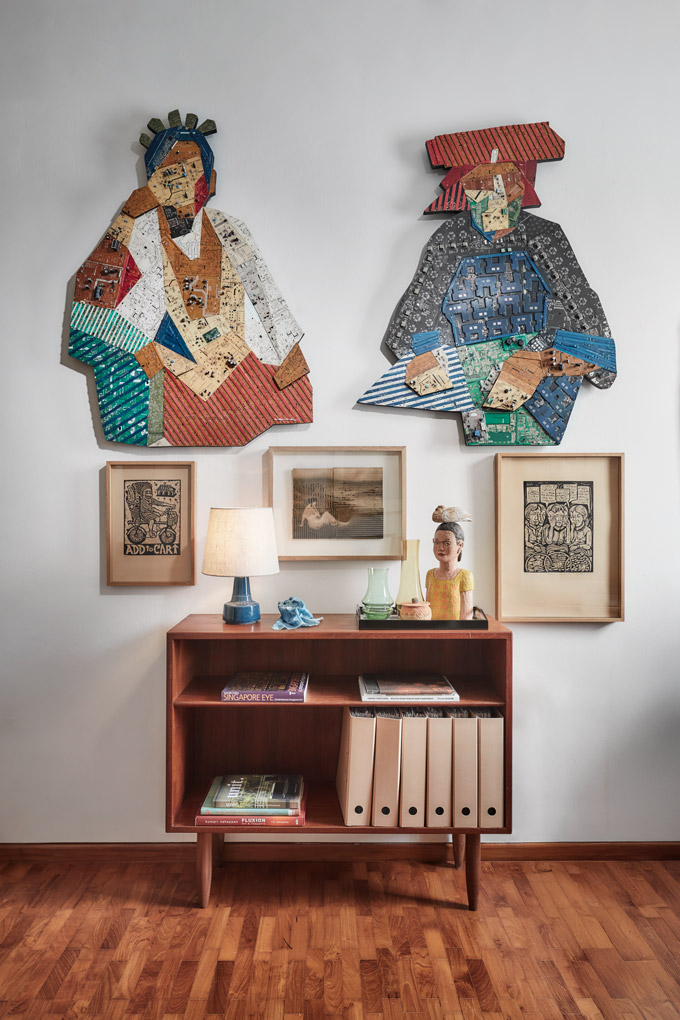
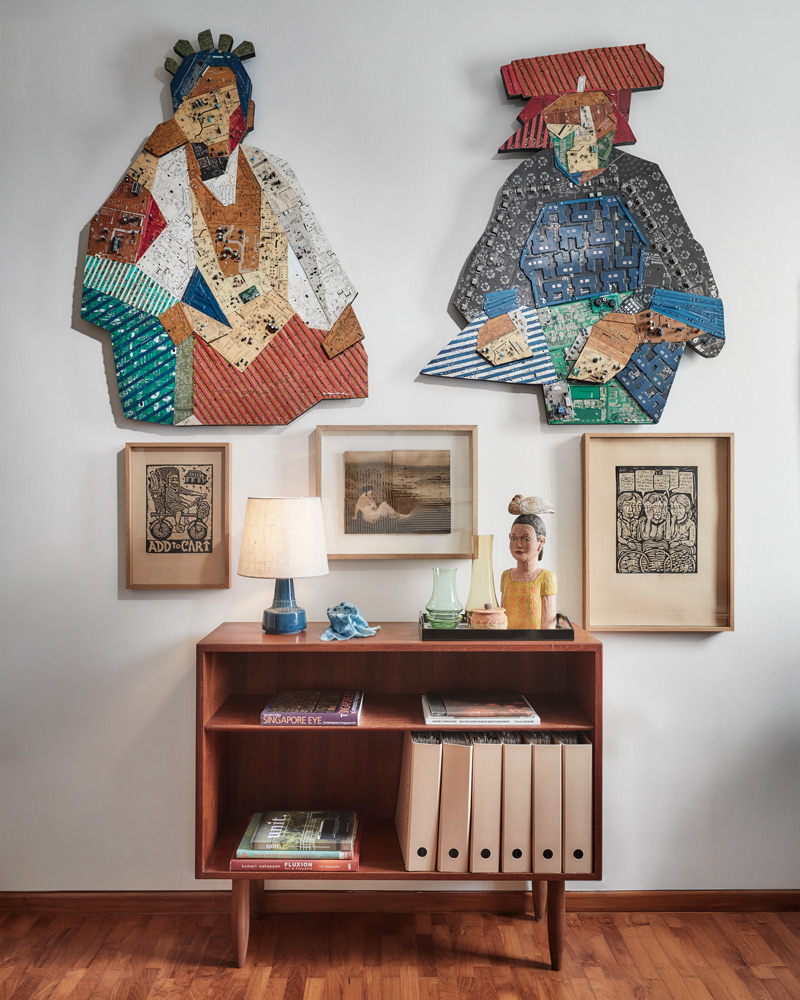
(Top row) Nor Tijan Firdaus, ‘After Seated Malay Girl by Redza Piyadasa’, 2021, e-waste on wood panel coated with 2K matte resin; Nor Tijan Firdaus, ‘After Samsui Worker by Lai Foong Mai’, 20212, e-waste on wood panel coated with 2k matter resin.
(Middle row); Leonard Aguinaldo, ‘Add to Cart’, 2021, woodcut print on paper; Jill Paz, ‘Woman (After FRH)’, 2023, acrylic on laser-carved cardboard; Leonard Aguinaldo, ‘Usap Usapan’, 2021, woodcut print on paper.
(On bookcase) Danielle Poon, ‘Restorative Spaces of Mourning; The Presence of Absence 2′, 2023, time, light, linen potassium, ferricyanide, ferric ammonium citrate, water, hydrogen; Lim Soo Ngee, ‘Pigeon and Girl’, 2022, painted woodcarving.
8 / 14
Krystina Lyon and Mark Budden, art collectors
How does one go about choosing a spot for an art piece—especially if they’re big statement artworks?
We like to think all our artworks make a statement in their own way but as we have a small apartment the larger works only have a few possible areas they can be hung to best effect. That is in the entrance hallway and a large wall in our dining room. This works well and we have had that artwork in the same space in our dining room in several homes over the years in Singapore and London. Large-scale works need visual breathing space and careful lighting is essential.
What are some additional considerations for buying art for one’s own living space?
Acquiring art is a joy and a passion for us. But once a works finds its place in our home maintenance becomes equally important – ensuring proper conservation, appropriate lighting, and thoughtful placement so that the work can continue to live and breathe with us over time. However, it is mostly just necessary to relax, enjoy the work and let it age gracefully with you.
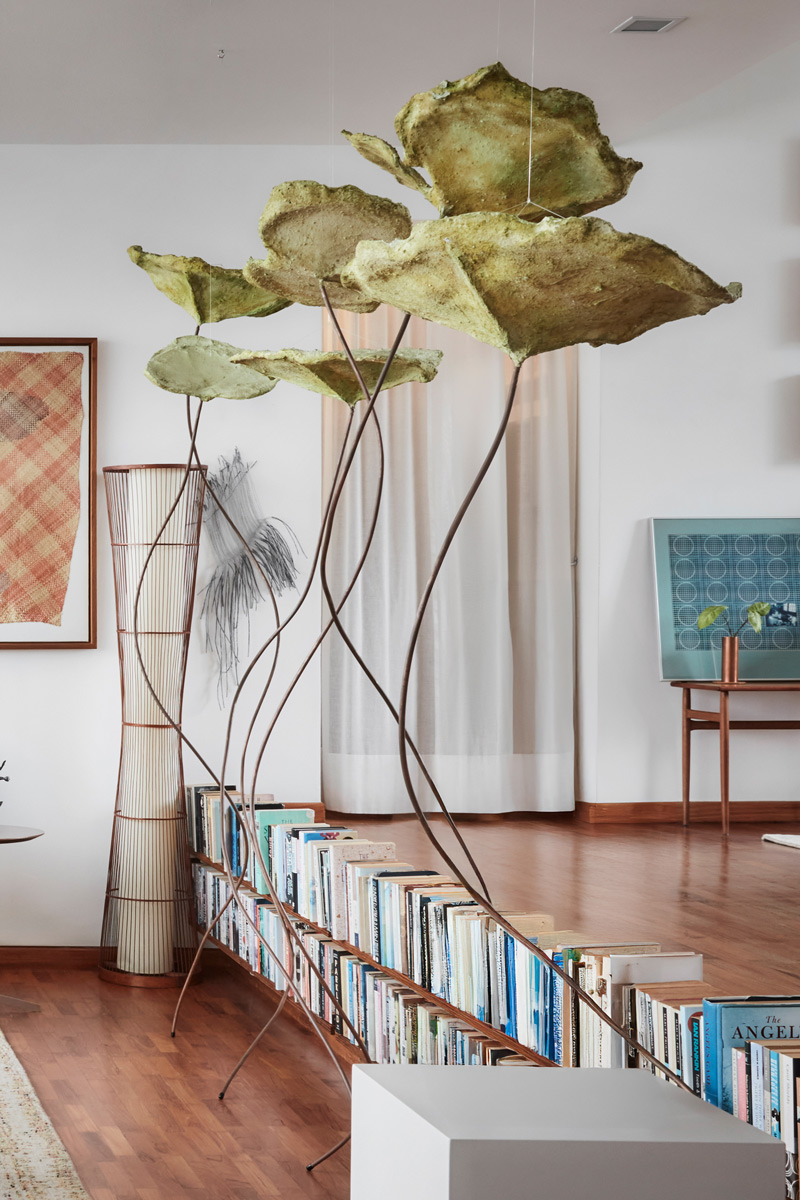
(clockwise from top centre) Eng Rithchandaneth, ‘Scars’, 2022, papier-maché, wire mesh and copper pipes; Kee Levi, ‘K & M Kissing’, 1997, (partial view) mixed media, colour photo, video still; Tulip Duong, ‘The Hybrid 3.0′, 2022, stone; Yee I Lann (with weaving assistance from Bajau Sama DiLaut Weavers from Pulau Omadal, Sulu Sea, Semporna, Sabah by Adik Alisya, Adik Anidah, Pacik Anneh, Kak Budi, Akid Dawing, Adik Dayang, Akid Della, Kak Indah Jariah, Kak Kanuq, Kak Kuluk, Kak Nulbaya, Adik Nur Tasha, Kak Roziah, Kak Sanah, Kak Sitti Rasun, Kak Sulman and Pacik Tularan), ‘Tikar/Meja 27‘, 2018-2019, (partial view only) Bajau Sama Di Laut Pandanus weave with commercial dye and sealant; Tith Kanitha, ‘Untitled’, 2023, hand coiled 0.7mm steel wire.

9 / 14
Usha Chandradas, lawyer, art historian and founder of Plural Art Mag
How would you describe the art in your own home—how did you decide on them?
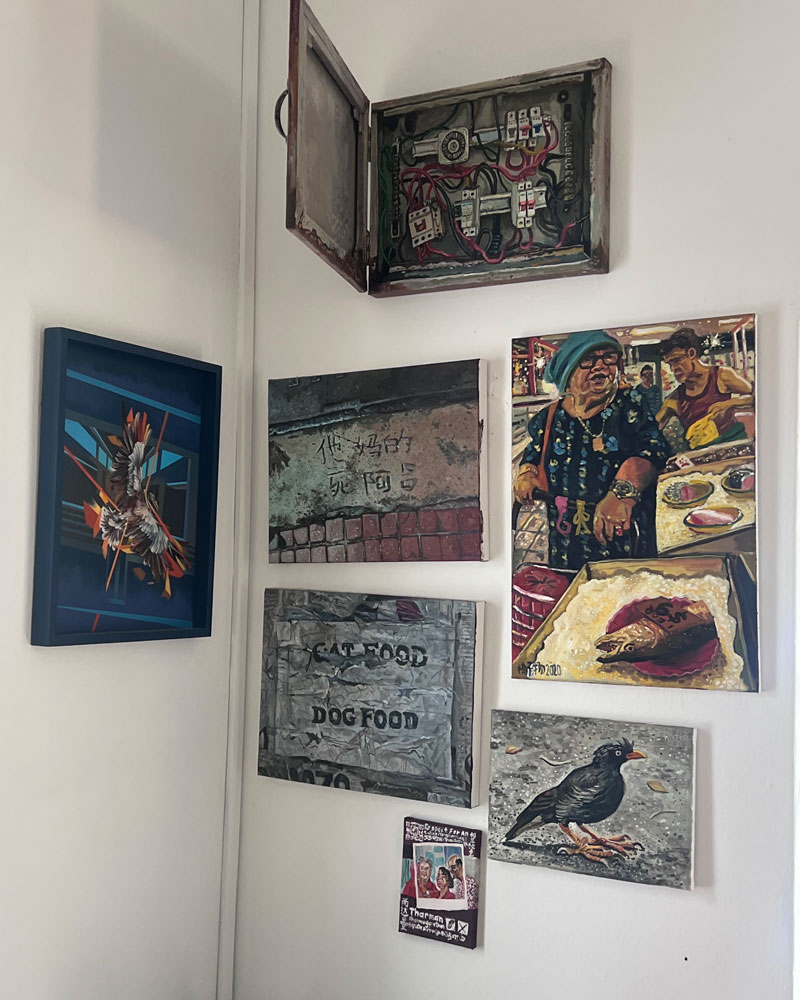
I’m an art historian and writer, so I tend to gravitate towards works that have a story behind them, or that carry some kind of socio-political or historical resonance. I also enjoy nerding out on art historical research, if there is any, on the works that I intend to purchase. I started out with a preference for paintings and photography, but over the years I’ve found myself becoming more interested in lightboxes, textile works, and sculpture.
10 / 14
Usha Chandradas, lawyer, art historian and founder of Plural Art Mag
If someone were attempting to refurbish their living space, would you recommend they start small with the art they purchase?
We’re fortunate to have many fantastic art galleries in Singapore. All you really need to do is take a walk around Tanjong Pagar Distripark, Gillman Barracks, Bras Basah Complex, or Kampong Glam, and you’ll find a good number of them. Fix your price point, think about the kinds of aesthetics you like, and then go forth. Talk to the gallerists you meet, ask for suggestions, and keep an open mind—you may come across works that interest you in ways you hadn’t anticipated. Many people think that art collecting or buying is only for the rich, and that is totally untrue. Art is available at many different price points, you just need to find the work that feels right for you.
If these things matter to you, you may also want to ask whether the artist has shown previously at art institutions or exhibitions, and whether the work you’re interested in might be requested as a loan for a significant show or museum in future. For collectors or buyers who are also thinking about investment value, these factors can be relevant to understand whether a work is considered important from an art-historical perspective.
Should one be buying art that complements specific areas in a home?
That does seem sensible. I’m personally terrible at that kind of planning as I have no real sense of spatial configuration. I tend to find works I like and can afford, and then make them fit around my home. I would not recommend this approach unless you’re a bit of a romantic and an idealist, as it’s highly impractical!
What is very important when buying art—and something I’ve often seen collectors and clients neglect—is making sure you have all the paperwork in place. Keep all certificates of authenticity, proof of payment, and receipts safely. If possible, ask your gallerist for good-quality photographs of the work that you can keep for your own records. These documents will be crucial if you ever decide to sell the work on the secondary market, or leave it behind as part of your estate.
How does one go about choosing a spot for an art piece—especially if they’re big statement artworks?
I think you have to ask yourself whether you can genuinely live with the work day in and day out. Will it continue to please you over time, and across different moods? Large statement works can be all-consuming and immersive. Setting aside investment value and price point, which are also important things to think about, ask yourself some very basic questions: Does the work speak to you? Does it make you happy, or remind you of something important in your life? Does the artist’s message resonate with you? If not, I’d say find something else, because art can be so much more than purely decorative.
(left to right) Shen Jiaqi’s ‘Interrupted Momentum‘, 51x41cm, acrylic on panel; A collection of Yeo Tze Yang’s works, Fost Gallery.
11 / 14
Usha Chandradas, lawyer, art historian and founder of Plural Art Mag
What are some additional considerations for buying art for one’s own living space?
Buying art doesn’t just furnish your home, it supports the community of living artists that our creative economy depends on. Personally, I enjoy buying works by living artists in Singapore and Southeast Asia because I like being part of the present ecosystem that sustains our local and regional cultural life. I also value being able to speak directly with artists, or with gallerists who work closely with them, to better understand what they were thinking when they made a work. You can, of course, learn a great deal from art-historical texts when artists are long gone, but it hits differently when they’re still around and willing to talk.I count many artists whose work I’ve bought as personal friends now and I am most grateful for those friendships which enrich my life greatly and inspire me.
Sustainability is also something I think about more these days. If you accumulate too much of anything, art included, you eventually have to consider storage unless you have many homes to fill up (I do not!). While art storage facilities in Singapore are excellent, they are also not cheap. I also find it rather sad when works sit unseen in storage. Collecting thoughtfully, with clear goals in mind, and in a way that allows your art to be seen and enjoyed, makes far more sense, whatever your budget may be.
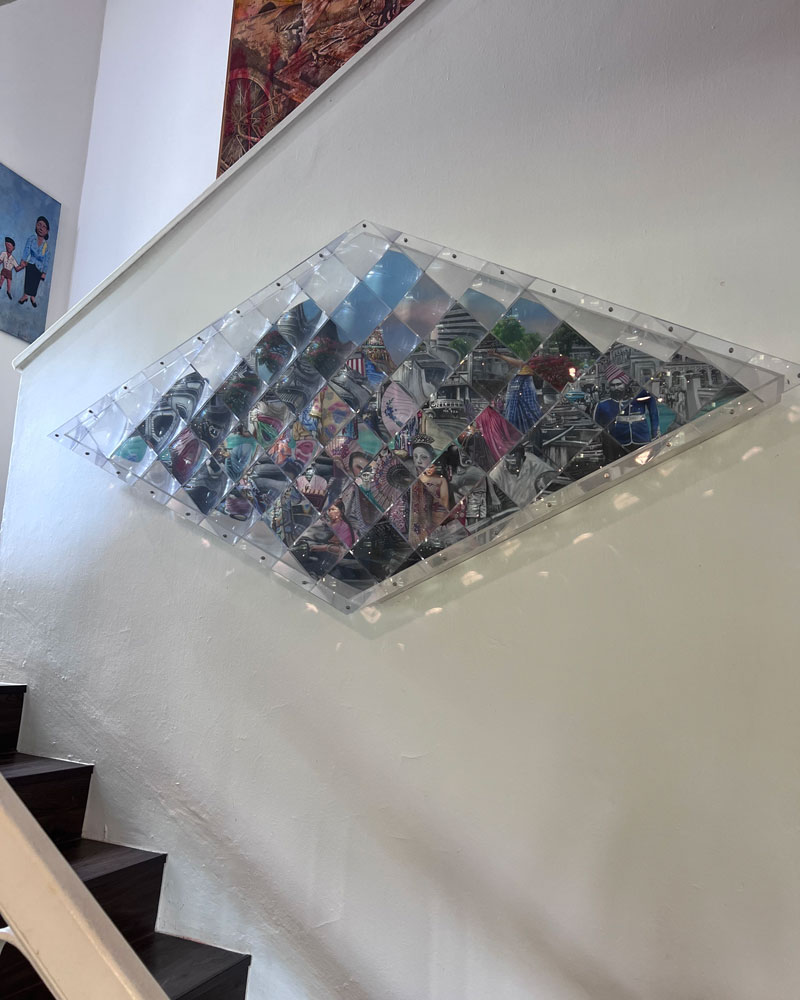
(wall) Suzann Victor, ‘Prismatic River‘, 2022, acrylic on canvas, acrylic strip and lenses, 88 x 178 x 17 cm, Gajah Gallery.
12 / 14
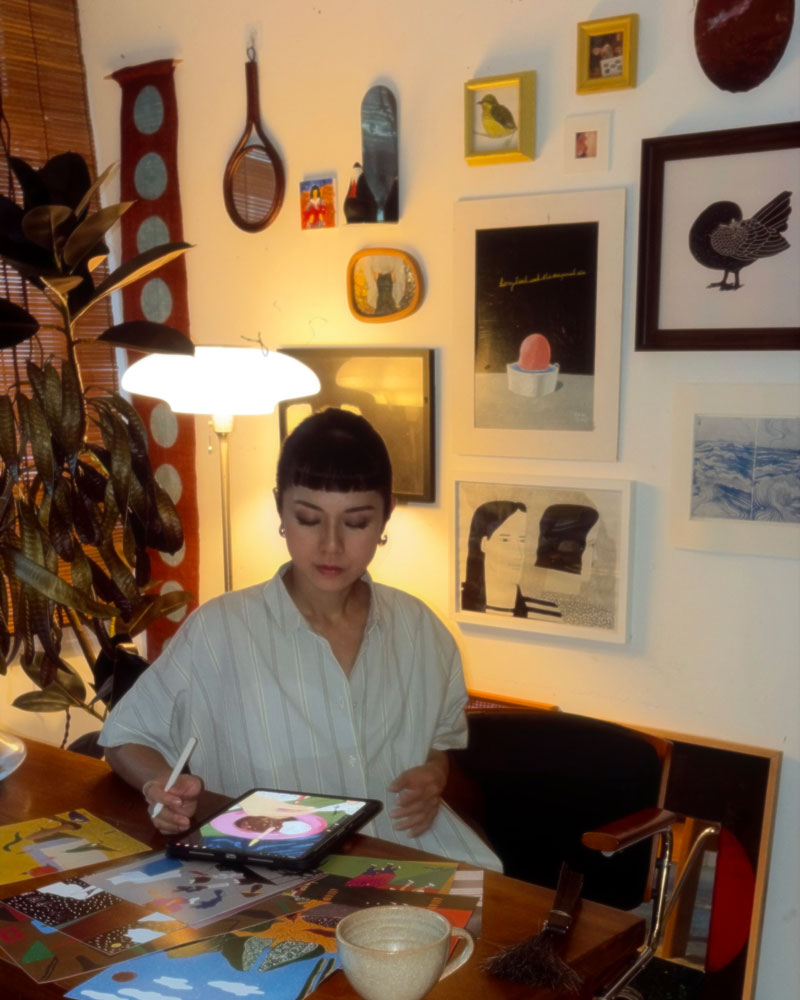
Lauren or @dirtydoodies, illustrator
How would you describe the art in your home—how did you decide on them?
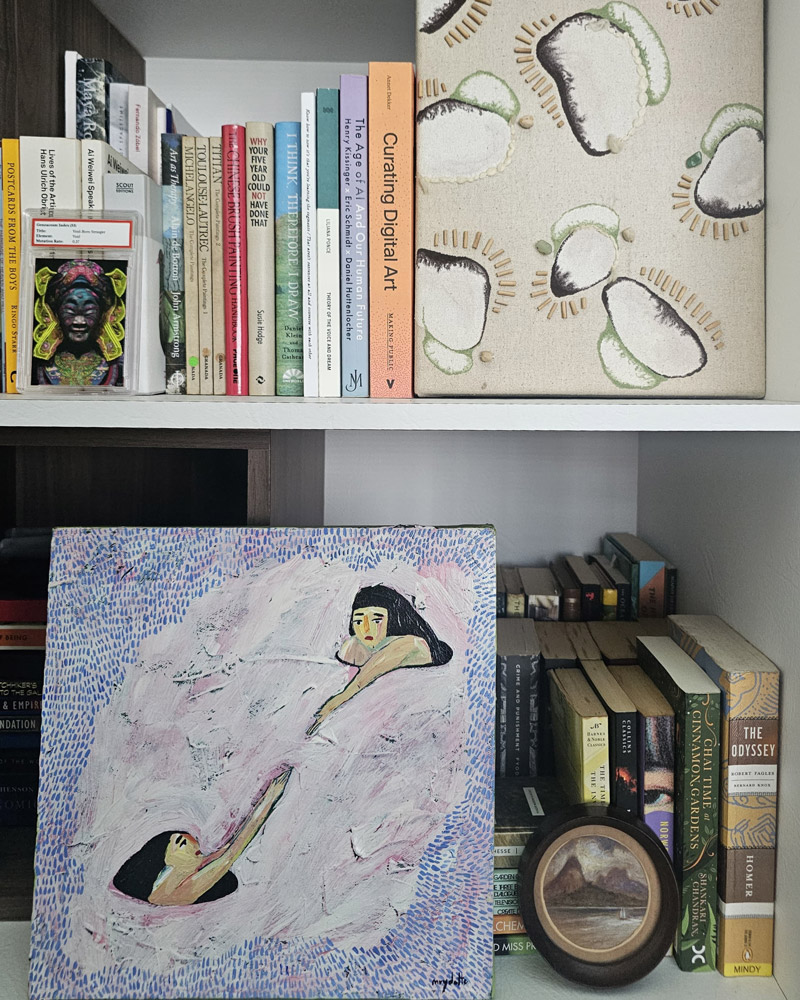
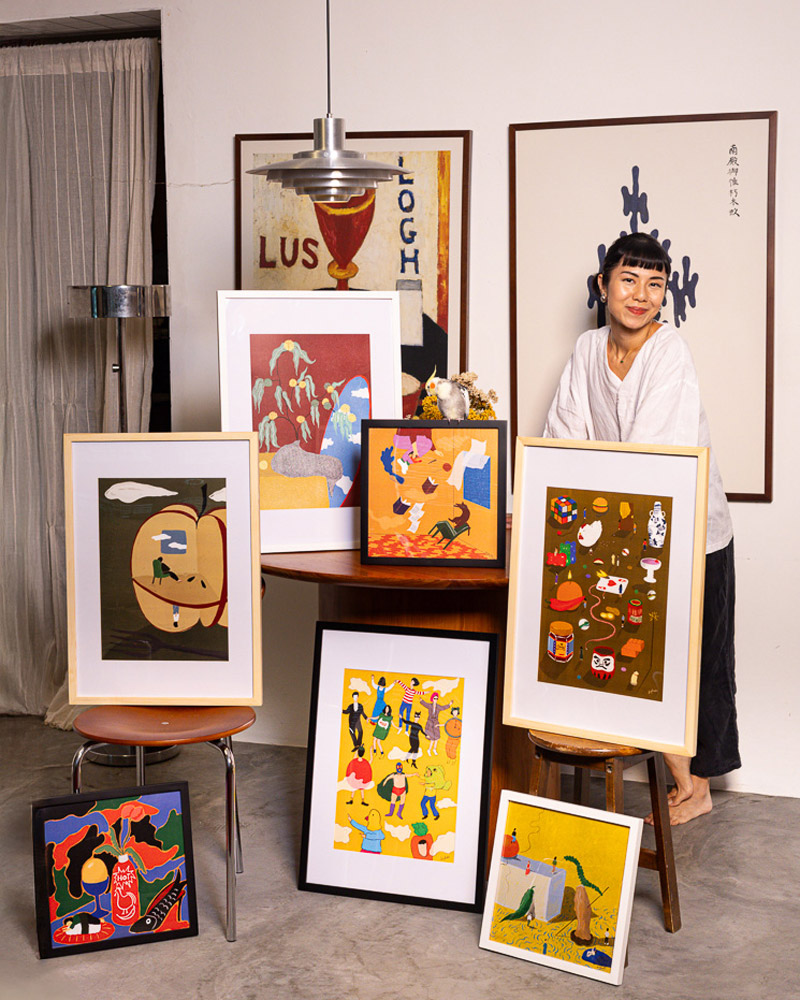
The art in my home is evocative, personal, and often surreal. Almost every piece is tied to a memory rather than an intentional design decision. Some works bought overseas—pieces by Yani Halim from Indonesia, or Brett Whiteley from Australia—are “emotional postcards” from a specific place or time. Others are intimate: my favourite is a sunbird sketch drawn by a friend’s mother, in remembrance of a beautiful olive sunbird bird we once rescued but passed.
There are also pieces I’ve drawn myself, including a painted canvas that is an ode to the insanely depicted hellscapes of Diablo 4 (Diablo was a calming presence in a period of my life where I was especially stressed). There isn’t a single unifying style, but there is definitely shared purpose. Looking at the wall in retrospect, each piece helps me remember something—whether it’s a feeling or a season.
What sort of art are you personally drawn to? Do you tend to have a spot in your home in mind when you purchase an art piece?
Whether I’m collecting or illustrating, I’ve always leaned towards domesticated surrealism or irreverence. I appreciate the tension when something strange or dreamlike exists within a conventional home setting, which keeps the space from feeling too ‘resolved’. Lately, I find myself drawn to imagery that evokes intimacy, and I find that my own illustrations of late have started to reflect the same sort of tenderness and introspection. In that sense the art on the wall is emotionally zoned; birds, micro landscapes and gestures cluster together in a tapestry of small feelings.
On that note, certain works I collect have thematic common ground, and that’s helped me to decide what sits next to what. For example, Yani Halim’s ‘Horny Head and the Artificial Sea’ placed next to Brett Whiteley’s depiction of the ocean form an obvious visual dialogue. That said, I don’t usually have a specific spot in mind when I buy art. If a piece makes me feel something—curiosity, nostalgia, discomfort—that’s enough. Placement comes later.
13 / 14
Lauren or @dirtydoodies, illustrator
If someone were attempting to refurbish their living spaces, would you recommend they start small with the art they purchase?
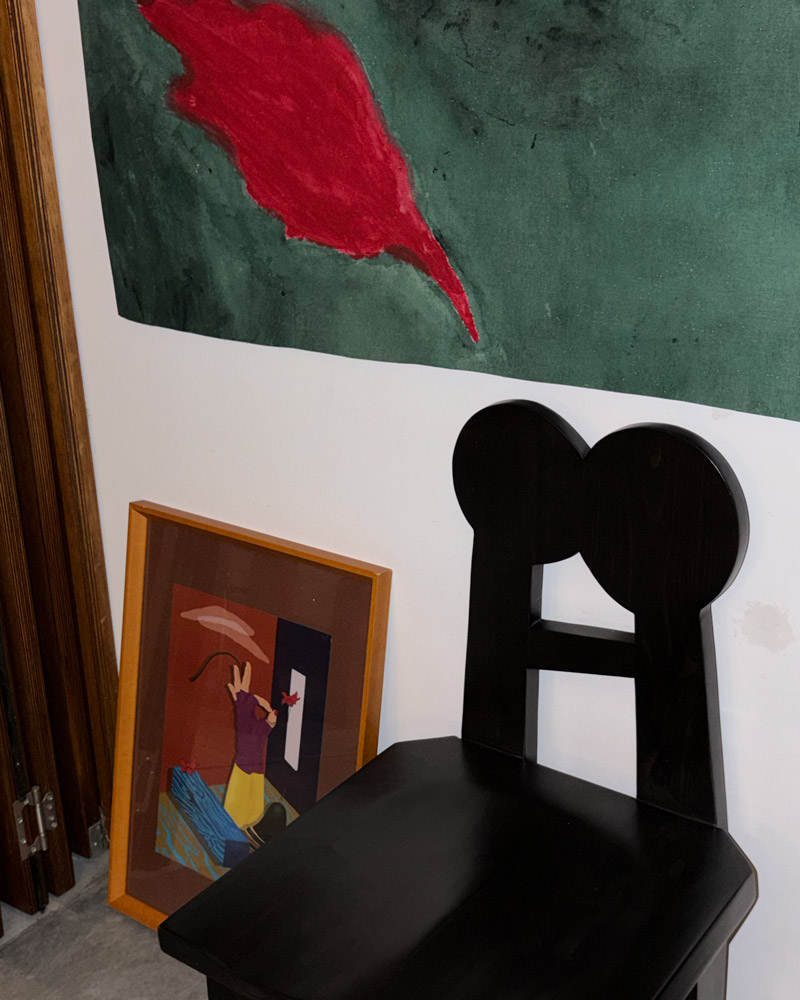
Not necessarily; I’d recommend starting with art that makes you feel something, regardless of scale. Size is often treated as a primary practical or aesthetic concern, but emotional resonance certainly matters most. And where size is concerned, large pieces can anchor a space, but small pieces go a long way to add intimacy and texture. This sentiment isn’t unique to me of course; there has been a noticeable global shift towards more collected, layered approaches to displaying art, where domestic gallery walls are starting to downsize and evolving into eclectic personal displays.
These are essentially clusters of smaller works, objects, mixed media, and personal ephemera on walls. Trend or not, I find this appealing because it allows for more emotion and narrative to surface, and my belief is that it actually requires more introspection to curate. I’ve noticed as well that my smaller pieces of work have started to gain traction vis-a-vis the larger ones, and in my own home, some of the most meaningful pieces are postcard-sized.
14 / 14
Lauren or @dirtydoodies, illustrator
How does one go about choosing a spot for an art piece—especially if they’re big statement artworks?
I believe art is something you live with, not something you “install”, and that placement is really about rhythm over a set of rules. Larger works tend to work best where the eye pauses, like at the end of a hallway, or above a piece of furniture that doesn’t compete visually—so they’re given space to breathe. I also think it helps to live with a piece before committing to a final spot. I often leave works leaning against walls or move them between rooms for a while. Over time, you start to notice where a piece feels most at ease, or where it quietly changes how you experience a space. That’s usually a better guide than any fixed formula.
What are some additional considerations for buying art for one’s own living space?
Above all, think of art not as an aesthetic but perhaps as emotional regulation. So buy art slowly, and buy it for yourself. Trends pass, tastes shift, but the pieces that stay are usually the ones tied to your own memories or feelings.
It also helps to remember that art doesn’t need to announce itself immediately. Some works grow on you to reveal new layers as you change, and those are often the ones that end up meaning the most.
