
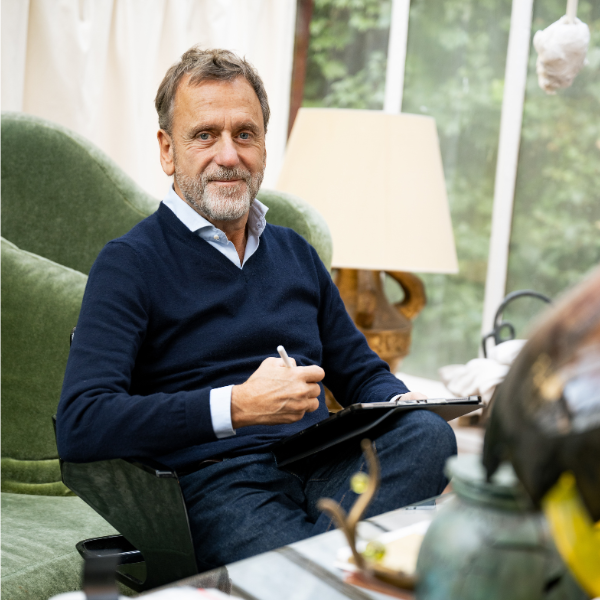
© Studio Vanssay
For his exhibition Arbres de la forêt, vous connaissez notre âme, presented by Cuturi Gallery at the Palais-Royal and later extended to Villa Noël in Noves, Hubert Le Gall brings together furniture, sculpture and decorative art within a world inspired by Victor Hugo.
Developed in collaboration with Kevin Cuturi and curated by Bruno Gaudichon, the exhibition reveals the richness of Hubert Le Gall’s practice, where function gives way to poetry, humour converses with material, and each work reflects an extraordinary dedication to craftsmanship.
François Blanc:
How would you define your creative territory today, between art, design, and sculpture?
Hubert Le Gall:
I have never really felt the need to choose between those terms. What interests me is the object when it becomes more than an object: when it retains a function, yet also opens a door onto the imagination.
Kevin Cuturi has always approached my work in this way, beyond rigid categories. With this exhibition, and through the curatorial vision of Bruno Gaudichon, the intention is precisely to reveal that freedom: a territory where furniture can become sculpture, and sculpture can still remain connected to use.
François Blanc:
What does the title Arbres de la forêt, vous connaissez notre âme mean to you?
Hubert Le Gall:
This line by Victor Hugo resonates deeply with me because it gives the landscape a soul. It evokes a benevolent nature that speaks to us, along with the animals that inhabit it.
For this exhibition, I wanted to create a sensitive, almost pastoral world in which the works appear like presences. The title offers a poetic entry point without confining the visitor to a single interpretation.
François Blanc:
Why did Victor Hugo emerge as the starting point for this exhibition?
Hubert Le Gall:
Victor Hugo possesses this extraordinary ability to bring the real and the fantastical into dialogue — nature and the human soul, the visible and the invisible. That sensibility closely reflects what I seek in my works: forms that may appear recognisable or familiar, yet subtly shift the viewer’s perception.
Bruno Gaudichon also understood how to support this literary and emotional dimension, giving the exhibition a strong narrative coherence without turning it into something overly didactic.
François Blanc:
What kind of atmosphere do you hope to create at Cuturi Gallery in the Palais-Royal?
Hubert Le Gall:
I wanted to create an exhibition that feels deeply personal, composed of works with a strong narrative presence. The Cuturi Gallery space at the Palais-Royal is intimate, almost like a capsule, and that interests me greatly: only a few works, but works that feel fully alive and in dialogue with one another.
Kevin Cuturi champions this idea of a focused and demanding space where every work matters. The exhibition should feel less like a presentation of furniture or sculpture, and more like an invitation into a world — my inner world — at once tender and powerful.
François Blanc:
How does the forest shape the imaginary world of this exhibition?
Hubert Le Gall:
The forest is a place of forms, mystery, and memory. It is both physical and psychological. Within it, there are branches, shadows, animals, and clearings, but also fears, dreams, and stories. Certain works, such as Branche-neige, naturally belong within this imaginary landscape.
Nature is never simply reproduced; it is absorbed, transformed, reinvented — almost theatricalised.
François Blanc:
What role does function continue to play in your more sculptural works?
Hubert Le Gall:
Function remains essential; it grounds me. A lamp must illuminate, a chair must welcome the body, a table must still be usable. But function should never limit the imagination. On the contrary, it gives it an anchor.
A work such as Sunset, for example, is a bookcase, but it is also an image, a landscape, a sculpture. I like this idea of “sculpting function.”
François Blanc:
How do you choose the materials that give rise to your works?
Hubert Le Gall:
Sometimes the material comes after the drawing, sometimes before. The encounter has to feel right. Certain works wait a long time before finding their material. Bronze, wood, glass, ceramic, or embroidery each tell a different story.
In Offrandes célestes, for example, the relationship between form, material, and narrative is essential: the horse, the vases, and the composition as a whole create a surreal, almost dreamlike presence.
François Blanc:
What role do artisans and craftsmanship play in your creative process?
Hubert Le Gall:
They are fundamental. An idea only truly exists once it finds its right form. Artisans bring precision, a deep intelligence of material, and sometimes even solutions I would never have discovered alone.
Their expertise does not simply execute a drawing; it enriches it. This is true across bronze, glass, wood, ceramic, and also in more complex works such as Calendrier de verre or certain embroidered pieces.
François Blanc:
How does humour enter into your forms, objects, and narratives?
Hubert Le Gall:
Humour creates a form of complicity. It is not about making people laugh, but about provoking emotion through a slight shift, a surprise, a sense of freedom.
Lapin-Câlin is a good example. The work may initially appear tender or familiar, yet it immediately alters our relationship to the chair and the object itself. Humour prevents solemnity; it keeps the works alive.
François Blanc:
How will the presentation at Villa Noël in Noves change the perception of your works?
Hubert Le Gall:
Villa Noël will create an entirely different relationship with the works by placing them within a new setting. At the Palais-Royal, the exhibition will feel concentrated and contained. In Noves, the works will enter into dialogue with the architecture itself. It is a deeply personal place — one of work, imagination, experimentation, and confrontation.
Within the architecture of Armand Pellier, the sculptures will be able to breathe differently. The extension of the exhibition allows the experience to shift from an imagined forest toward something more physical — an encounter with space, landscape, and atmosphere.
Arbres de la forêt, vous connaissez notre âme
28 May – 26 September 2026
24 Galerie de Montpensier, 75001 Paris
Extended presentation: 15 June – 1 August 2026
Villa Noël, located within the Domaine de Bournissac in Noves (Bouches-du-Rhône)
